Know what's in every box without opening it.

IMPS is a free, self-hosted inventory for the things you keep in storage. Photograph each item, put it in a numbered box, and stick a QR label on the box. Scan the label with your phone to see what's inside.

Demo password: imps · the demo resets regularly.

Everything you stored, one scan away

A photo of everything

Add items from your phone's camera. A picture says "which lamp" faster than a description.

QR box labels

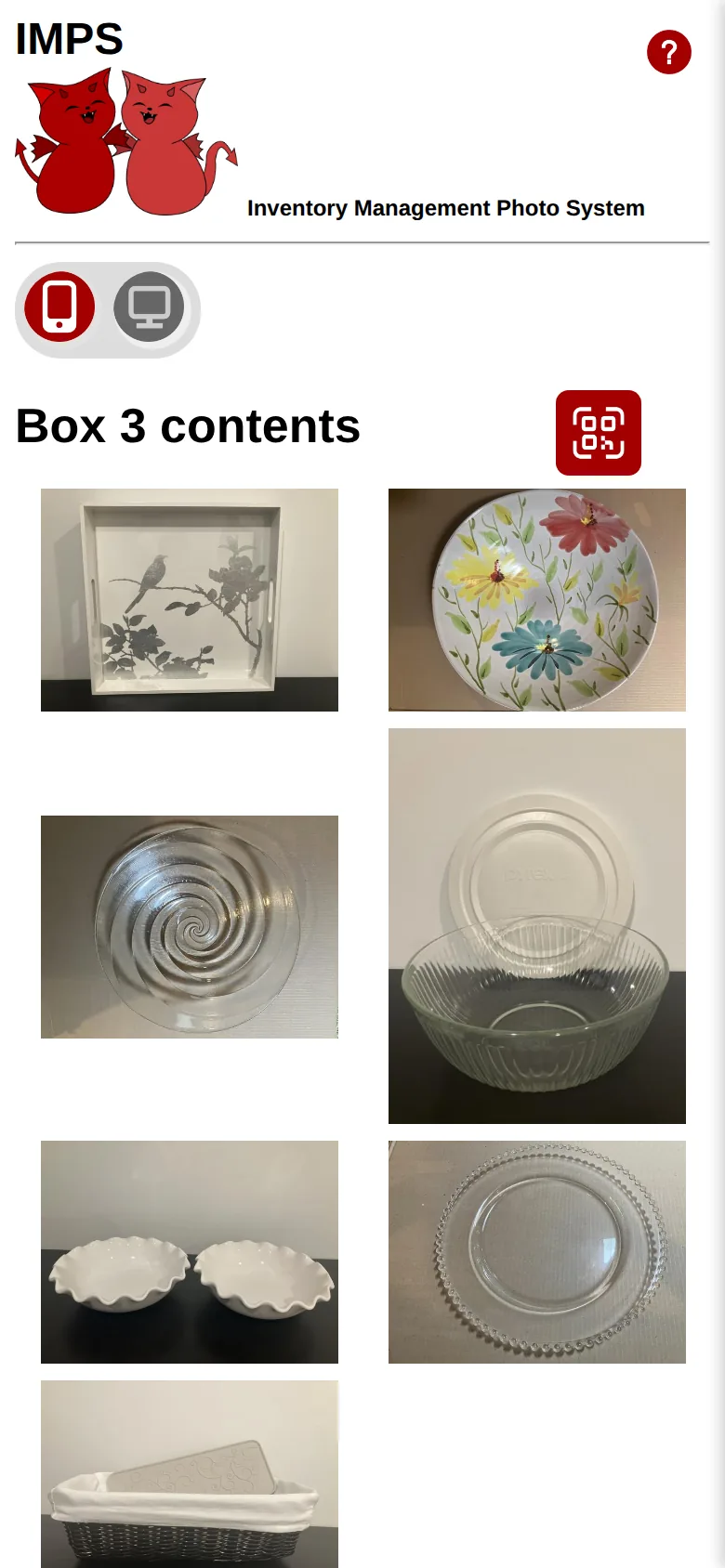
Print a label for each box. Scan it to see the box's contents, without taking it down from the shelf.

Phone and desktop

Photo tiles for browsing on a phone, a detailed table for editing at a desk.

Find it fast

Search by name, or browse by box, category or location: the attic, the garage, the storage unit.

See it in action

Screenshots from the demo's sample inventory.

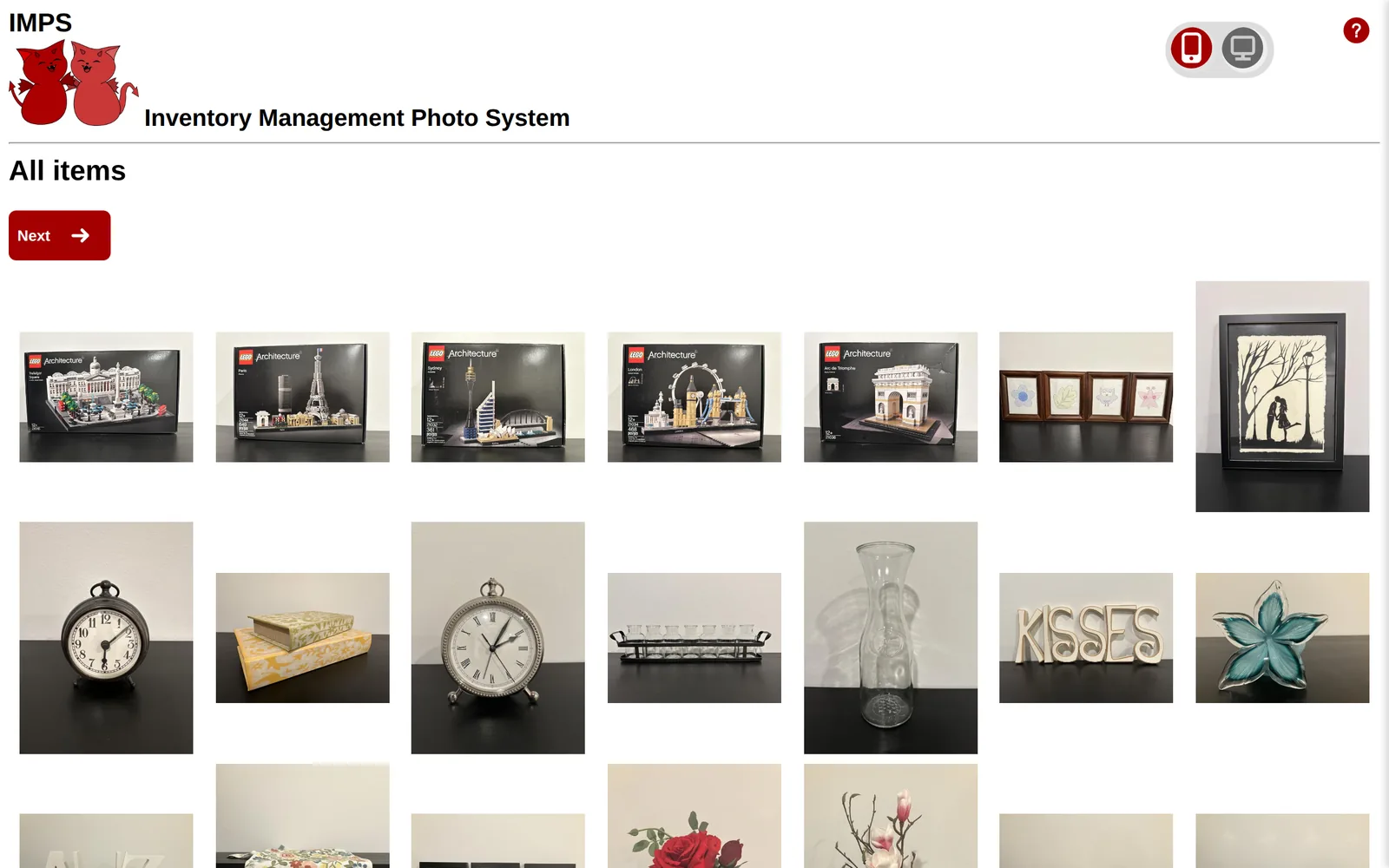
All items as a grid of photos
All items as photo tiles
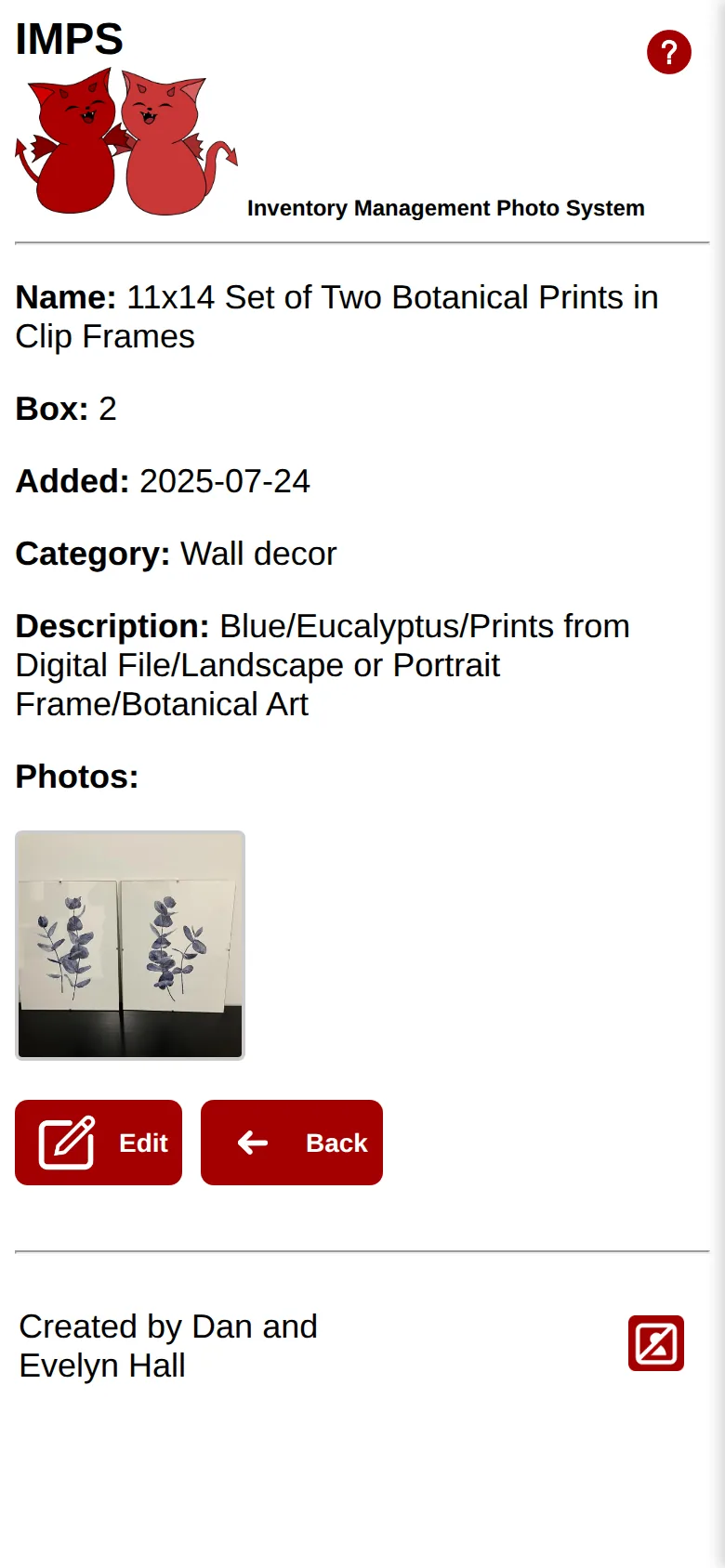
An item's details on a phone
Item details on a phone
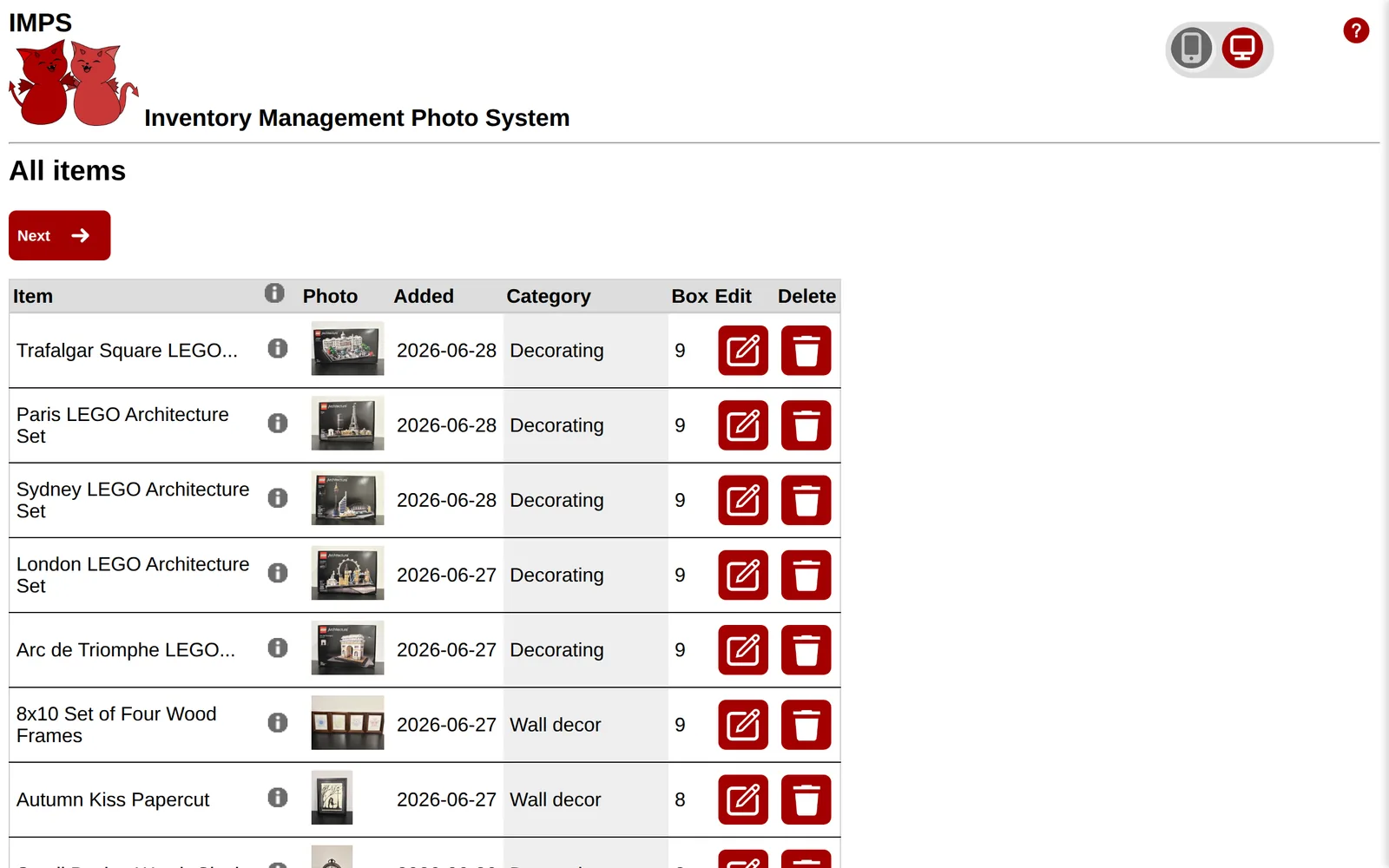
All items in the detailed table
The detailed view, for editing
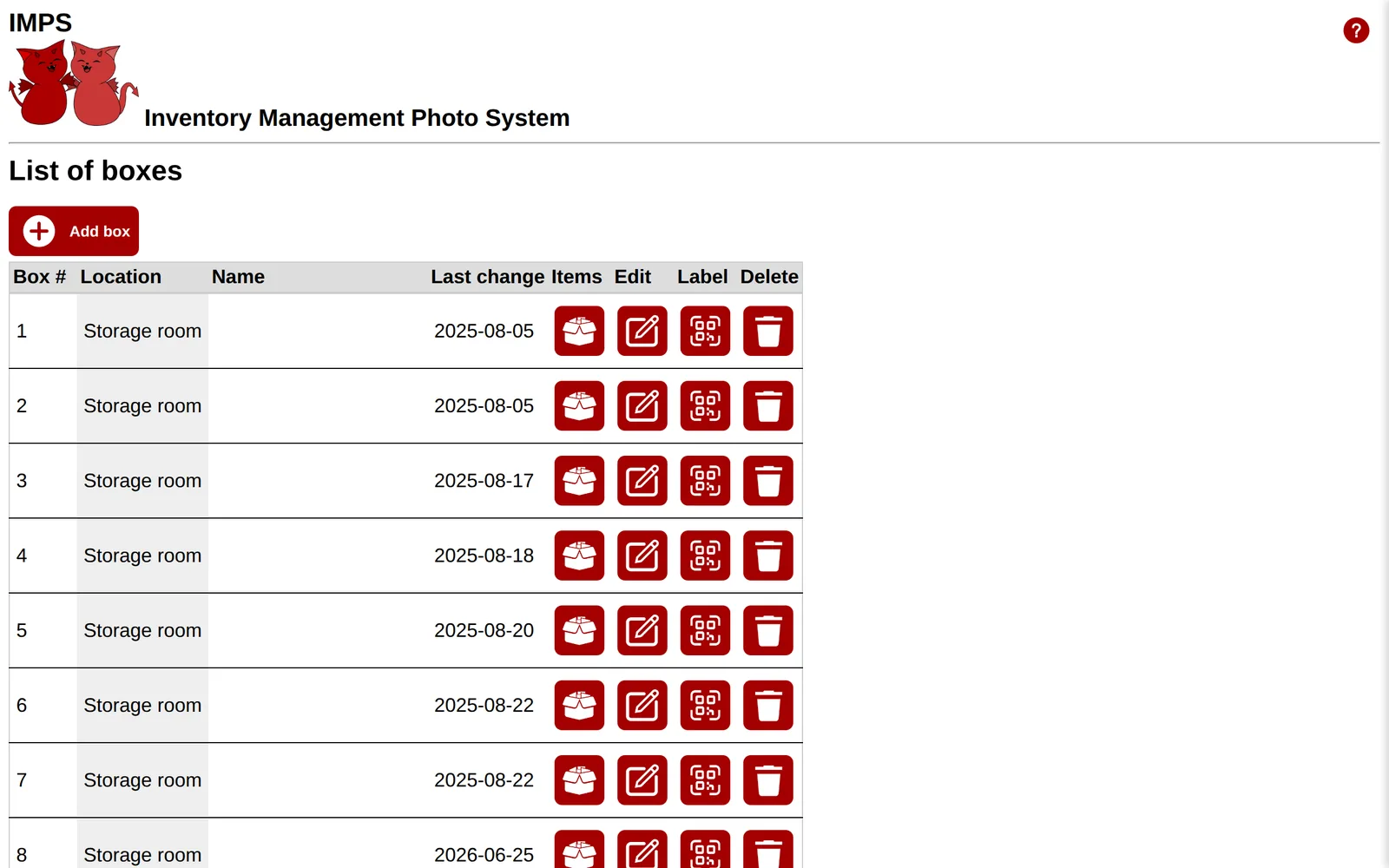
The list of boxes
Boxes, with label printing
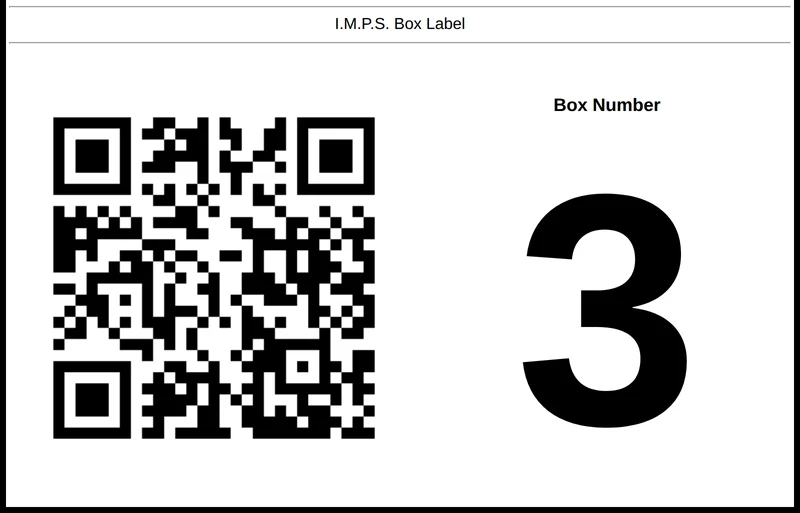
A printed box label with QR code and box number
A box label, ready to print

Install in a few minutes

You need a computer on your home network with Docker. A 64-bit Raspberry Pi works.

mkdir -p ~/imps && cd ~/imps
curl -fsSLO https://raw.githubusercontent.com/airbornedan/IMPS/main/deploy/docker/docker-compose.yml
curl -fsSL -o .env https://raw.githubusercontent.com/airbornedan/IMPS/main/deploy/docker/.env.example
# edit .env: your server's LAN address and two passwords
docker compose up -d
  1. Run the first three commands.
  2. Edit ~/imps/.env with a text editor.
  3. Run the Docker command: docker compose up -d.
  4. Open http://<your server>/ in a browser.
  5. The setup wizard creates the tables, offers sample items, and asks for a password.

Details: the Docker guide. Prefer no Docker? Download the .zip or clone from GitHub and follow the manual install.

Built for self-hosting

  • Your inventory and photos stay on your own hardware
  • No cloud service, accounts or telemetry
  • Docker image for amd64 and arm64 (Raspberry Pi)
  • Python (Flask) with MariaDB
  • One-click database backup and restore
  • Free and open source, MIT license

Questions

Is it easy to add items?

Yes. Type a name, enter the box number and take a photo with your phone. Category, description and extra photos are optional. Adding from a box's page fills in the box number for you.

How do I find something?

Search by name, or browse by box, category or location. Every item shows its photo and the box it's in.

Does it work on my phone?

Yes, in the phone's web browser; there's no app to install. On a small screen IMPS shows items as photo tiles.

What do the labels need?

Any printer. Each label has the box number in large type and a QR code that opens that box in IMPS. Phones scan it with the normal camera app.

How do I update?

In the folder with your compose file, run docker compose pull and then docker compose up -d. Your data is kept.

How do backups work?

The control panel backs up the database with one click and restores from a backup. With Docker, two volumes hold everything: the database, and the photos, labels and backups.

Can several people use it?

Yes. Everyone on your network logs in with the same password. There are no separate user accounts.

Can I reach it from outside my home?

IMPS is built for a home network and has a single shared password, so don't expose it to the internet. To use it away from home, connect through a VPN such as WireGuard or Tailscale.

The IMPS logo: two red imps

Why IMPS

Dan and his daughter Evelyn wrote IMPS together, as a coding project and to keep track of their own boxes. It's free to use. If it saves you an afternoon of opening boxes, you can buy us a coffee.

Questions, bugs and ideas: GitHub issues or the contact page. What's new: the project history.